
Manitoba is a collage of unique experiences, relaxing day trips and interesting place to visit. Each week, we will post our most recent outing. We encourage you to explore, as well.
Day Trip Through the West Interlake
Royal Winnipeg Mint (scroll down)
Winnipeg The Forks Meeting Place
Winnipeg Floodway: An Engineering Marvel (scroll down)
April 11, 2026. East to Whitemouth and Beausejour (scroll down)
April 24 Road Trip Selkirk, Lockport & Grand Marais
April 11, 2026. East to Whitemouth and Beausejour (scroll down)
Our first road trip of the spring, 2026, takes us 100 km east of Winnipeg, toward the Whiteshell and Agassiz Forest areas. Travelling east from Lagimodiere Blvd, we drive along Route 115 through south Transcona, past the Floodway, along Highway 15. This route takes us through Dugald and Anola, two bedroom communities that are growing quickly with affordable homes and condos. The highway is undivided, one lane of pavement each direction and 100 kph speed limit along the sections not in the local communities.
After Anola, where Highway 12 crosses, we travel east through Vivian, a small hamlet. Along the way, we experience mostly small aspen, birch and some evergreens. There are marshy areas interspersed and we cross both Cooks Creek and Whitemouth River before reaching Elma, at the eastern point of Hwy 15. From here, we could continue travelling south and then east, toward the south Whiteshell area, but we opt to turn north, crossing the Whitemouth again in the hamlet of Elma.
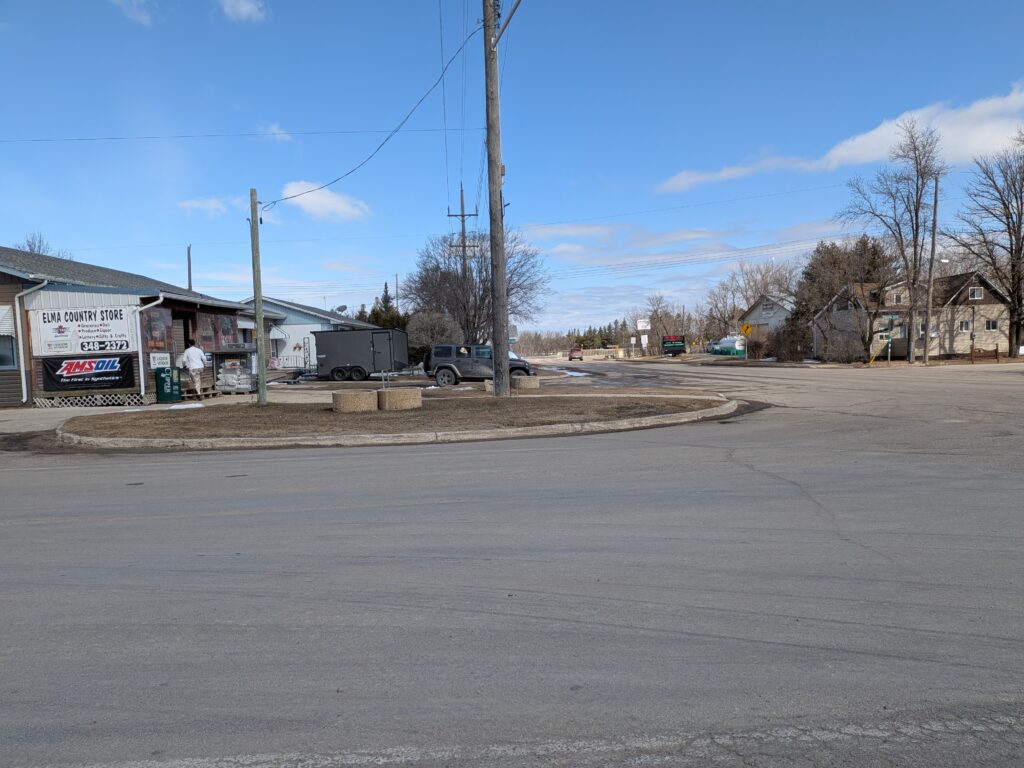
A few kilometers north, we turn left onto Hwy 44 (right would take us to Rennie, in the Whiteshell Park area) toward Beausejour. A dozen or so kilometers along, we enter the town of Whitemouth.
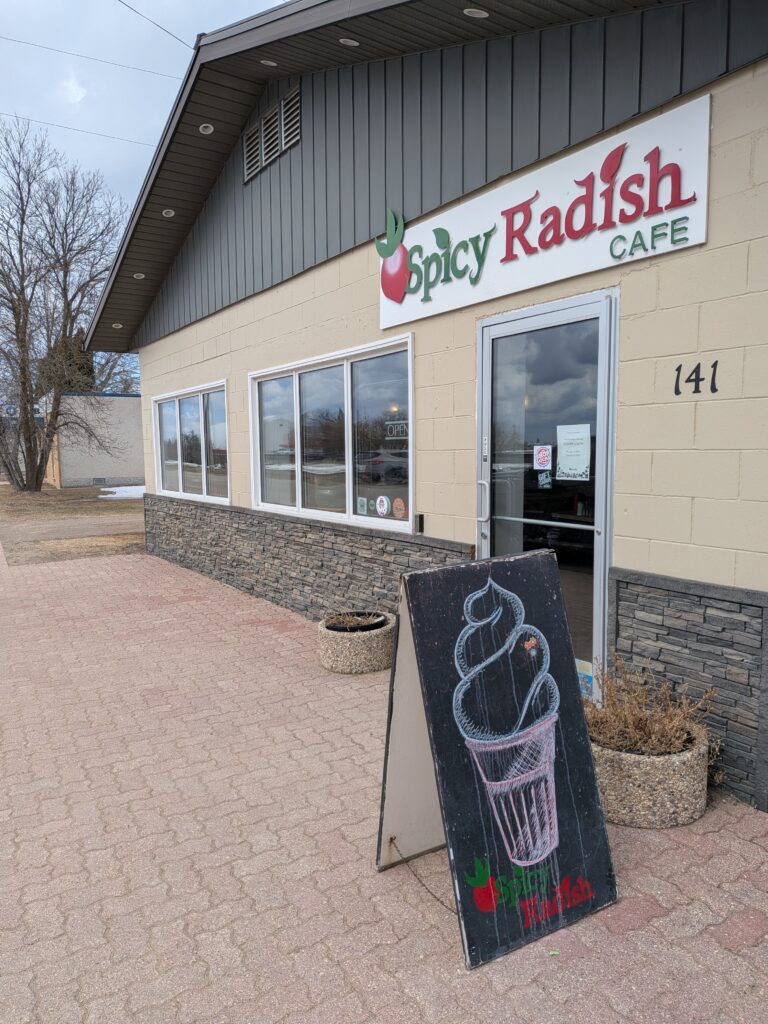
We are dining at The Spicy Radish with our road trip friends. It is a small (roughly 50 seats) diner that serves both conventional café food and interesting dishes, including an excellent beet and spinach salad. Burgers are phenomenal and prices very reasonable. We have arrived just before noon, and by 12:30, the place is bustling, even though the town is small and quite a distance from larger centres.
Luckily, we found the place. If we had relied on my wife’s navigating, finding the Spicy Radish would have been impossible. At first, she called it The Smelly Onion. Then The Crispy Radish. Then, I think something about Turnips. This is her calling card. She manages to turn tiramisu into Terry Sunami, tofu into futo and the tiny two-seater car into a two-four instead of a ForTwo. She makes cucumber salads with only tomatoes and manages to find a butchered name for a variety of objects, quite innocently. Definitely, she is part of our road trip entertainment.
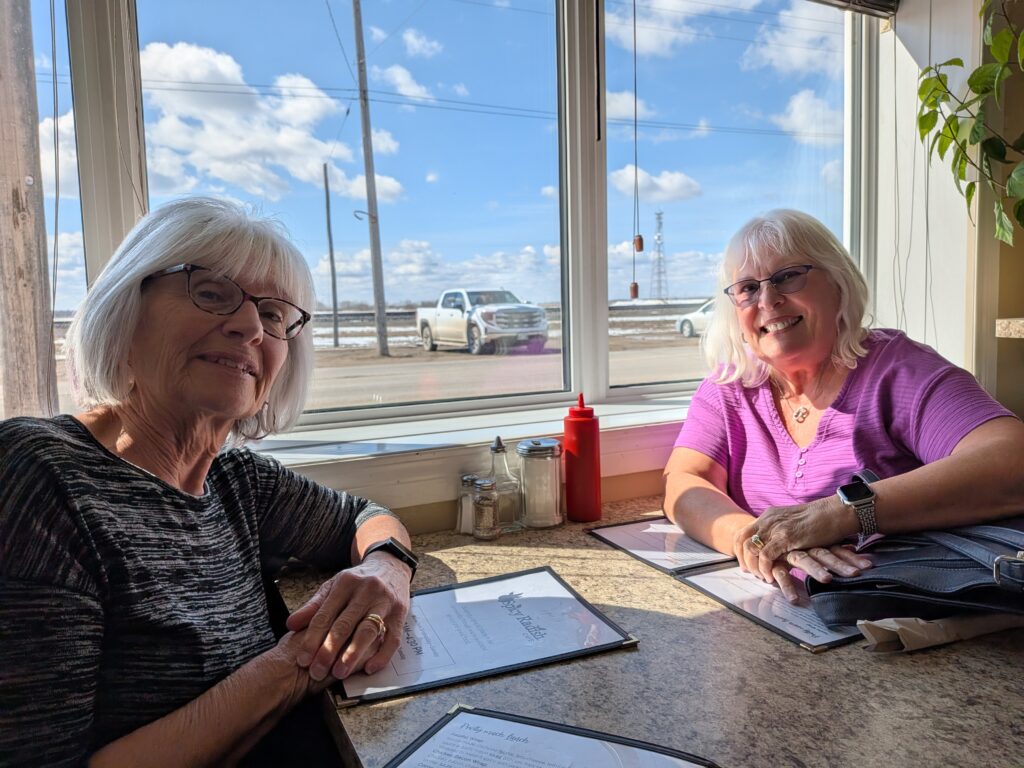
These rural diners often conceal great surprises, and the Spicy radish, with its Mennonite employees, provides a comfortable “Kitchen” ambiance. Our view is rather bland: the CPR railway line from the city of Winnipeg, carrying myriad containers of goods east and west.
Instead of enjoying their homemade desserts, we choose to continue west along Hwy 44 to Beausejour, passing through stands of evergreen forests, as ell as a few expansive gravel pits partially hidden in the bush.
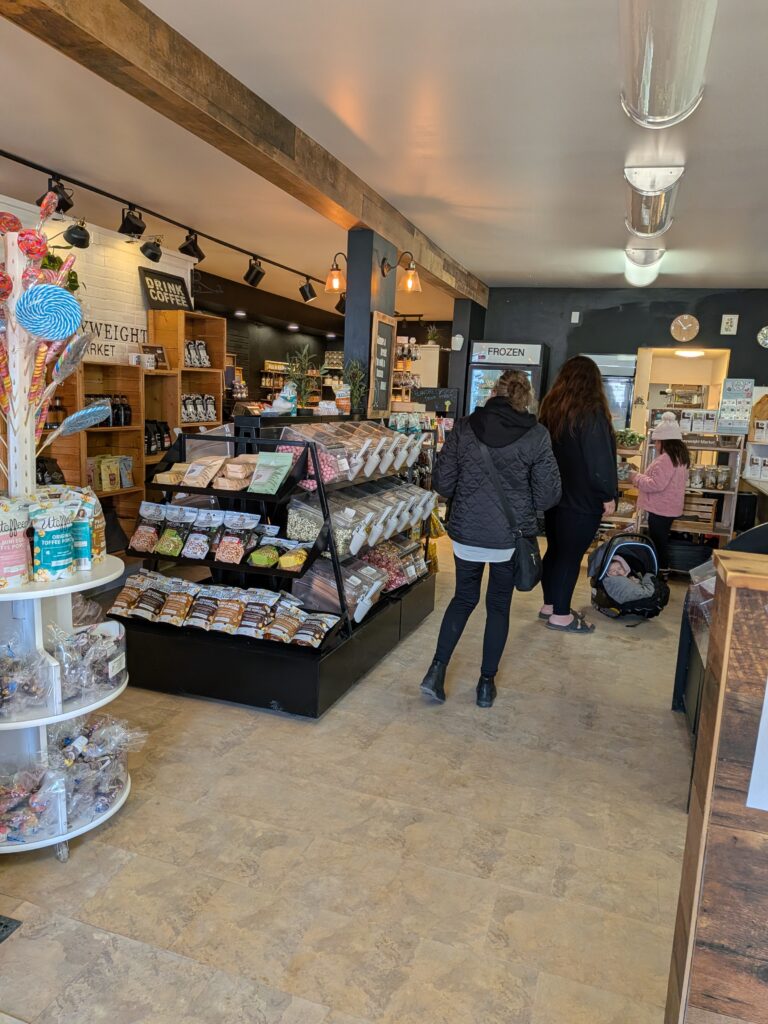
Beausejour is a town and community of about 5,000-10,000, and every retail type you would want is here, including lumber & hardware, restaurant, bars, clothing, discount shops, grocers, butchers and car dealers. But we are here for one specific outlet: Pennyweight.
Pennyweight has been around here for a few decades but continues to grow. Its primary focus is on bulk foods, and it has a large selection. All price competitively.
We want the ice cream, though. It is a very rich, thick, soft ice cream, exceptionally creamy. With its selection of more than 30 flavours, Pennyweight brags that they can create more than 1,000 options. While we would love to try each one, the portions are so large and so reasonably priced (under $5.00 for a “medium” tub that is equal to most large containers), that we settled for one each. Absolutely delicious! We’ll be back here several times this summer.
Now, stuffed, we head home along 44, then south back to the city instead of going through Lockport and along the Red River on Henderson. We’ll save that route for another day.
April 24 Road Trip Selkirk, Lockport & Grand Marais
Libau Bog, Sandhill Pines, Mars Sandhill Golf, South Beach Casino, Grand Marais, Selkirk, Lockport
This week’s road trip takes us from Winnipeg, north along Highway 59 to Libau, east to Sandhill Pines Campground and Mars Sandhill Golf Course, back to Hwy 59 to South Beach Casino, past a few of the east shore Lake Winnipeg beaches to the community of Grand Marais, then back south again to Selkirk and Lockport, before returning to Winnipeg. It is a quiet trip, because we are a few weeks early for the Manitoba summer cottage country exodus.
Manitoba, like northern Ontario, definitely is a cottage and camping province in the summer, with innumerable lakes and dozens of high-quality beaches, along with an array of great campgrounds and golf courses. We pack the majority of our outdoor fun (not all: we have a great fall and winter outdoor season, too, for the brave) into four or five months. The first of the mainstream campers and cottage owners arrive at their summer destinations on the May long weekend, and the bulk pack up camping on the Labour Day weekend in September, but many of us enjoy (and sometimes endure) the shoulder seasons.
We opted to take an early drive, to see how well winter has been beaten back. The ice is still on the lake, there is lots of snow in the headlands and along the north face of wooded areas and everything is still quite brown, but, in a week or two, all that will change!
Highway 59 is a divided highway until you almost reach the First Nations Brokenhead Reservation and the village of Scantebury. More correctly, it becomes a two-way single lane each way highway just as you approach South Beach Casino, but we are turning east, after heading north for about 55 kilometers. While Highway 317 would take us all the way to Lac du Bonnet, we are only travelling 10 kilometers along this paved road.
At the 9K mark, we turn south to the Mars Sandhill Golf Course. Along the east side of the golf course, the virgin forest has been subdivided into large lots and almost two dozen new homes have sprouted here in the past five to eight years. It is pastoral, almost secluded, with winter feeling isolated but summer feeling gloriously connected to nature. It is not uncommon to see deer, bear, coyotes, fox, wolf, and even lynx in the area, along with a wealth of birds.
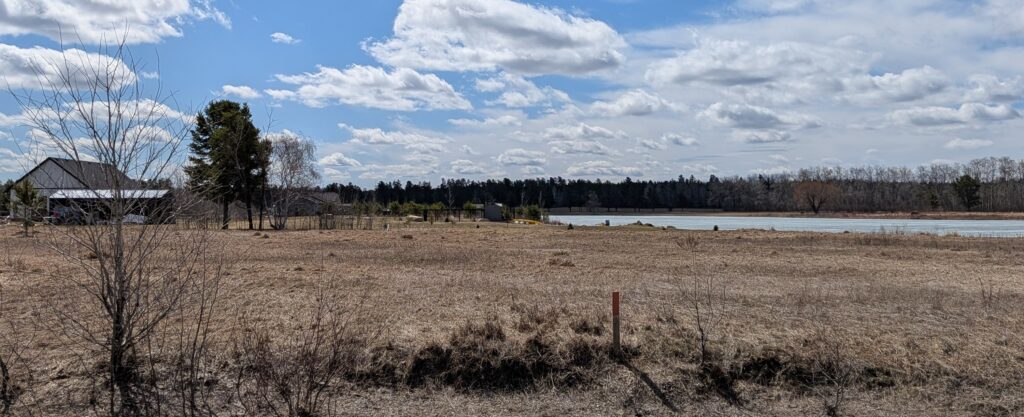
Part of the Millenium (TransCanada) Trail runs past here, and it is a great opportunity to spend a day hiking in the wilderness.
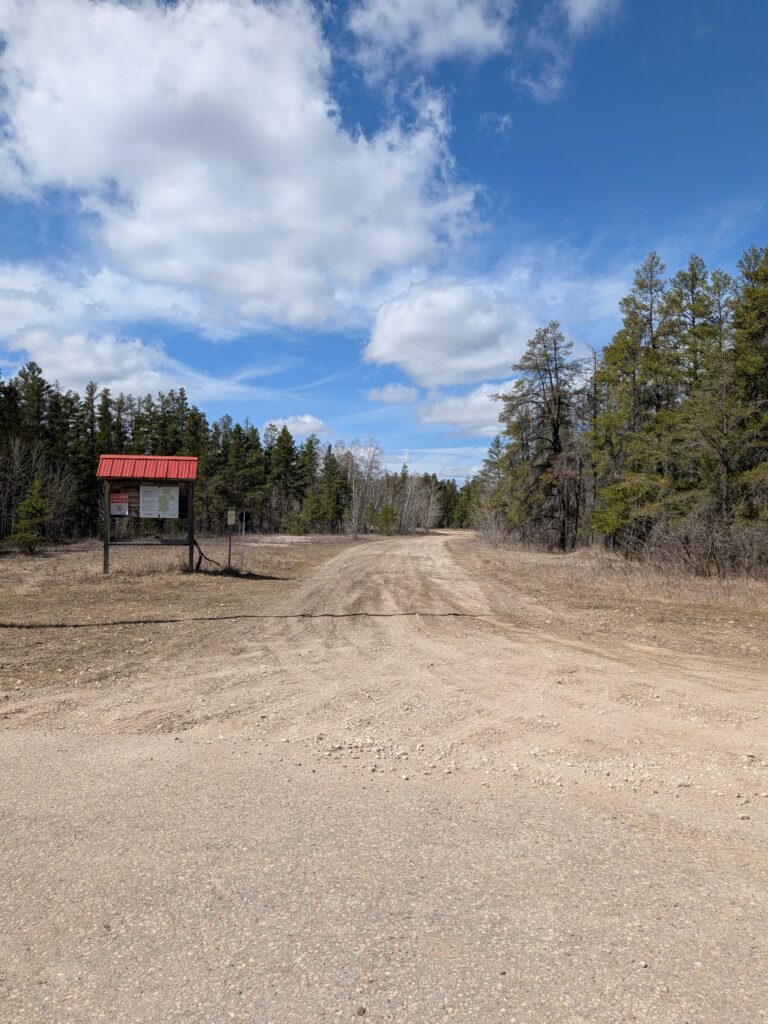
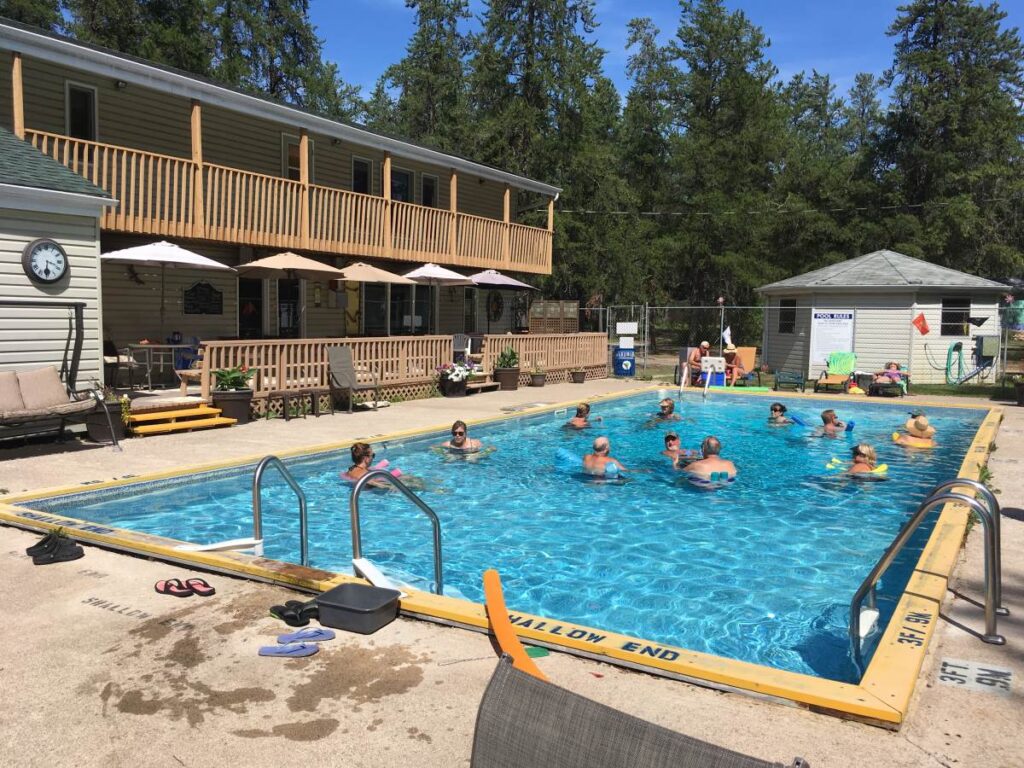
Just a half kilometer east of the golf course, on Hwy 317, is Sandhill Pines Campground. It is a 65-site nicely hidden campground with a substantial clubhouse, pool and large RV sites. It also has seen a few iterations. For decades, it was home to the Crocus Nudist (sorry, naturist) Colony. When the club began to experience financial problems (possibly because the campers had no place to carry their money), it became a 55 Plus campground. Perfect for older campers who wanted to banish both loud ATVs and equally loud children. Then, this year, it opened up to families, while keeping the campground free from ATVs and dirt bikes. But the plethora of golf carts attests to the age of the current campers.
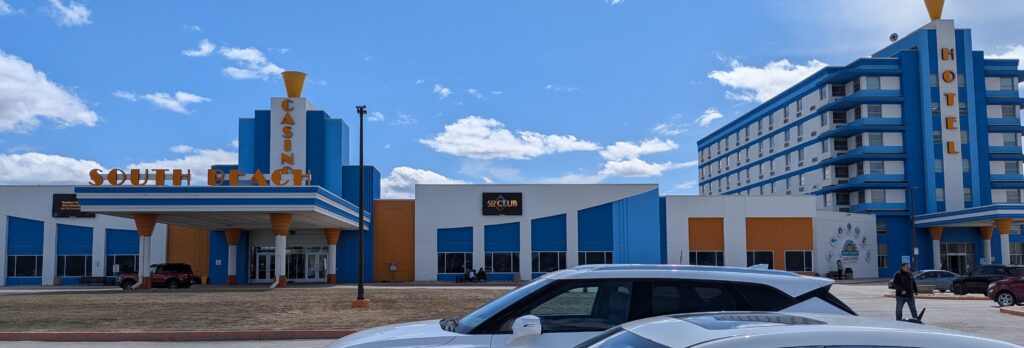
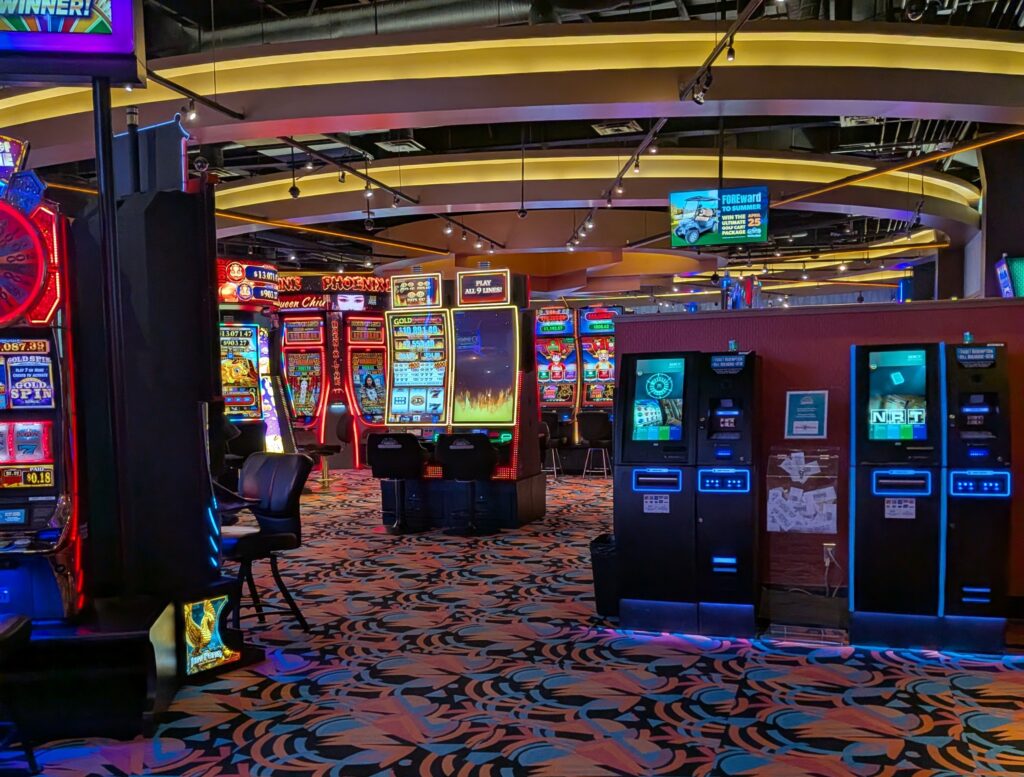
Now, we retreat along 317, heading back to 59 and then about 15 km north to South Beach Casino, owned by the local First Nations people. It is a great place to lose (or occasionally win) some money, to dine at the two restaurants, to enjoy weekend entertainment, or to stay and play in the indoor pool that is a part of the hotel attached to the casino. We opt to gamble a bit, because it is our birthday month and we get a gift of $10 each to gamble.
Now, we head north past Patricia Beach and Beaconia (one of them has a nudist area, but I’m not sure which one). Traverse Bay and Balsam Bay also have beach areas along the route, but Highway 59 divides into the extension of Highway 12, and we turn west on 12 to head to Grand Marais.
This is a small, mostly seasonal community right on Lake Winnipeg, with lots of shops and food places open in the summer. Now, only a few are open. L’il Lucy’s Gift Shop and Sand Bar Restaurant are two of them. Both are open on weekends year round, and both are worth the visit.
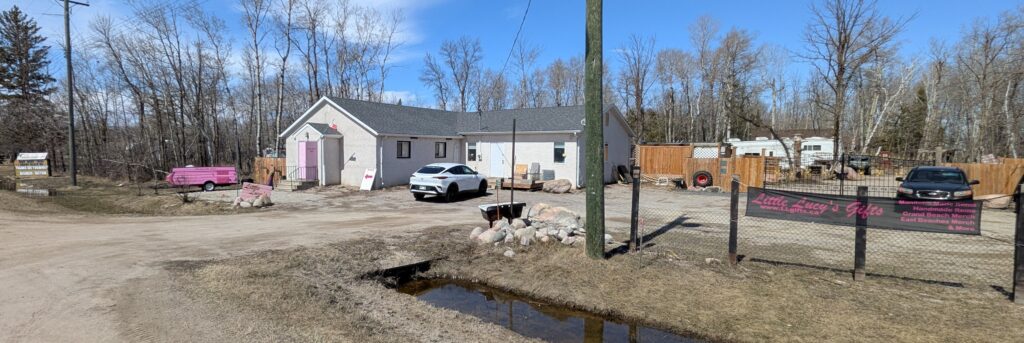
Grand Marais is the retail side of Grand Beach, a provincial park on the lake with what many consider to be a world class beach. There are more swimming spots along the east side of the lake, including Victoria Beach, but Grand Beach easily is the most popular day trip beach in the province. Others, like West Hawk and Falcon Lakes in the Whiteshell, Gimli on the west side of Lake Winnipeg and Clear Lake in Riding Mountain National Park may dispute Grand Beach’s #1 status, but, being only an hour or so from Winnipeg and having massive amounts of sandy shore and shallow water, it definitely is a favourite among young people during the weekend and families during the week.

Around 2 pm, we head back to Winnipeg, but we stop for an early dinner at South Beach. Too early for the buffet, we enjoy pizza and salad in Mangos.
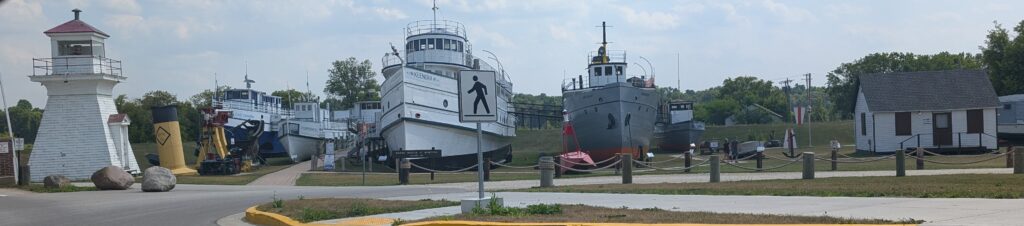
Selkirk is next on our route. At Highway 4, we turn west over a bridge that rises like a small mountain over the Red River, north of Selkirk, before turning south into town. For years, this was known as the bridge to nowhere, as it seemingly had no destination point or start. Instead, it has become a vital link for lakeside residents to shop in the largest shopping centre in Selkirk or connect to the rest of the Interlake.
While we are not visiting the Selkirk Marine Museum today, it is an ideal tourist spot.
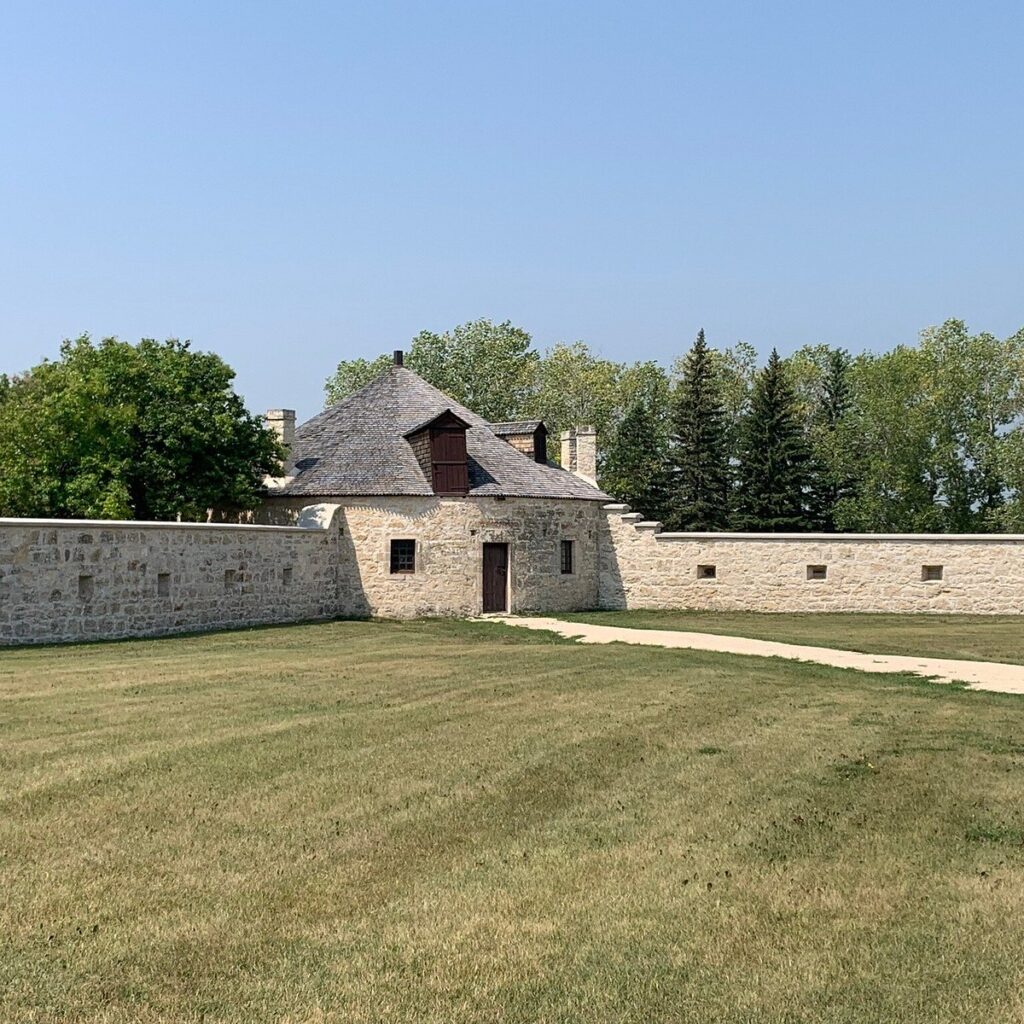
Just south of Selkirk, Lower Fort Garry is a rejuvenated replica of the old fort and community essential to Canada’s early fur trade in western Canada.
Further down Highway 9, we turn left to Lockport. This once was the site of waterway locks that enabled freighters to move up and down the Red River. Now, it is a tourist point of interest. Lockport, however, has weekly summer events, the world-famous Skinners and Half Moon Hot Dog Drive Ins, and now, the point where scores of fishermen and hundreds of white pelicans vie for the abundant fish in the river at the locks. Of note is our stock of huge catfish, rivalling the world’s largest. The huge catfish statue in Selkirk may actually be smaller than the biggest catfish caught in the area. (That’s a typical fisherman’s exaggeration.)
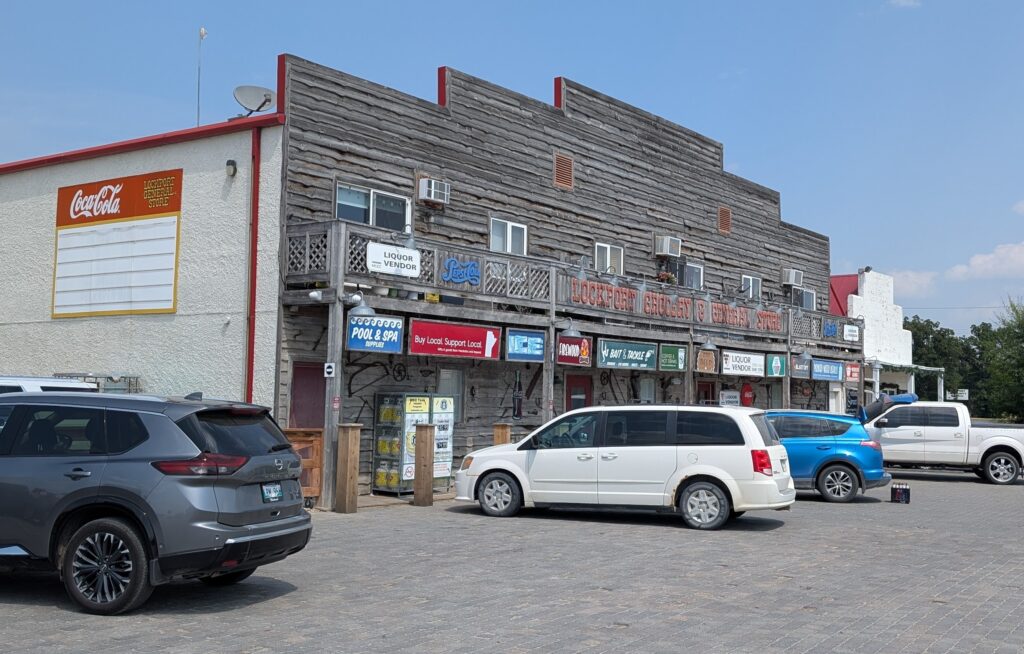
Now, we head home, following old Henderson Highway along the Red River into the city. It may be too early for flowers, but the abundance of reds and whites is just as pretty. Since the Americans voted Trump into office, Canadians have found national pride and fervour, and nowhere is this more evident than the hundreds of red and white Maple Leaf flags that adorn a majority of homes from Lockport to Winnipeg along Henderson.
We left at 10:30 in the morning, arrived home at 4:30 in the afternoon. It was perfect weather, perfect road conditions and a perfect day.
Winnipeg Floodway: Duff’s Ditch Saving Winnipeg
When people think of man-made wonders, few would think of a feature affectionately known as “Duff’s Ditch, but this 47-kilomter long channel that runs from the Red River just as it enters Winnipeg long a semi-circle route to a point many kilometers north at Lockport is now a Canadian National Historic Site.
When it was built beginning in 1962, it was the second largest earth moving project undertaken in the world, second only to the Panama Canal.
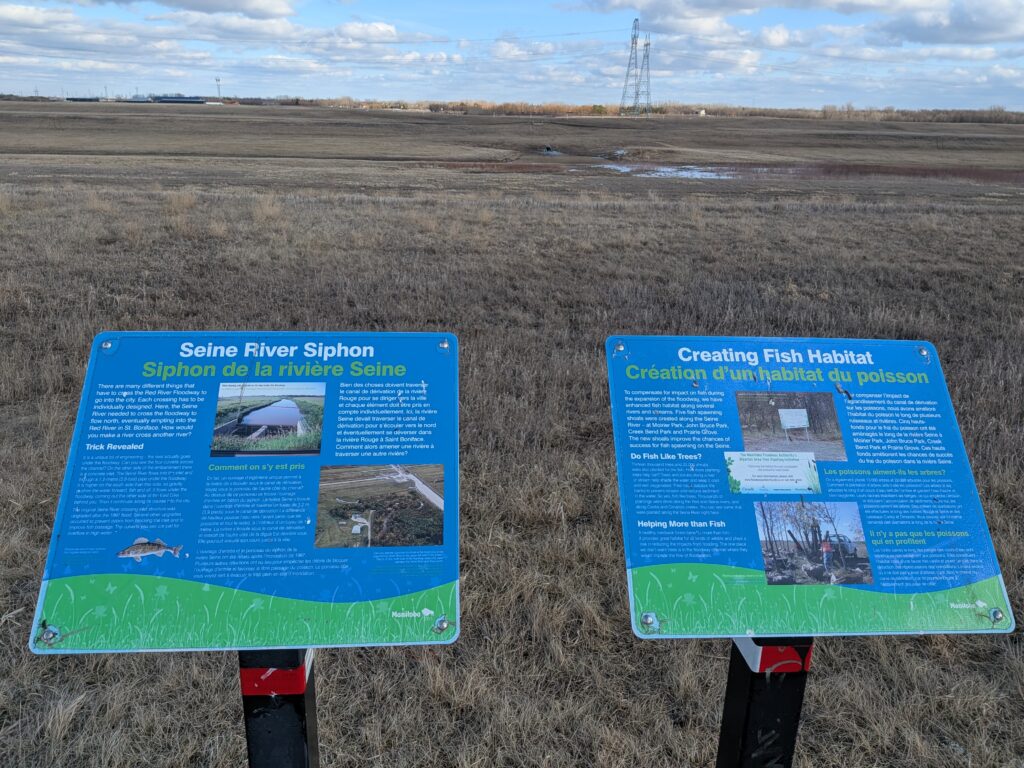
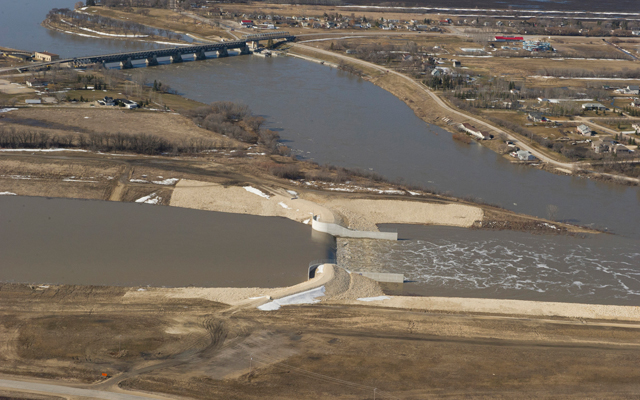
Designed to protect the city of Winnipeg against the frequent floods in the spring, many mocked its creation and branded it disdainfully as Duff’s Ditch, after the premier of the province, who undertook the project. Yet, numerous times it has helped the city avert catastrophe from spring flooding and now is admired world-wide.
However, in 1997, Manitoba experienced a 1 in 140 year flood, and the province undertook to expand the floodway to between 9-20 meters deep, capable of handling flows of 2,500 cubic meters per second.
That flood also precipitated another engineering marvel, mostly because of the speed with which the Z-dyke was built, when water from the Red River threatened to inundate Winnipeg in spite of the floodway.
This 40-42 km dyke was constructed of old cars, derelict dump trucks and school buses and an assortment of other material, along with huge quantities of earth, to create a barrier against overland flooding.
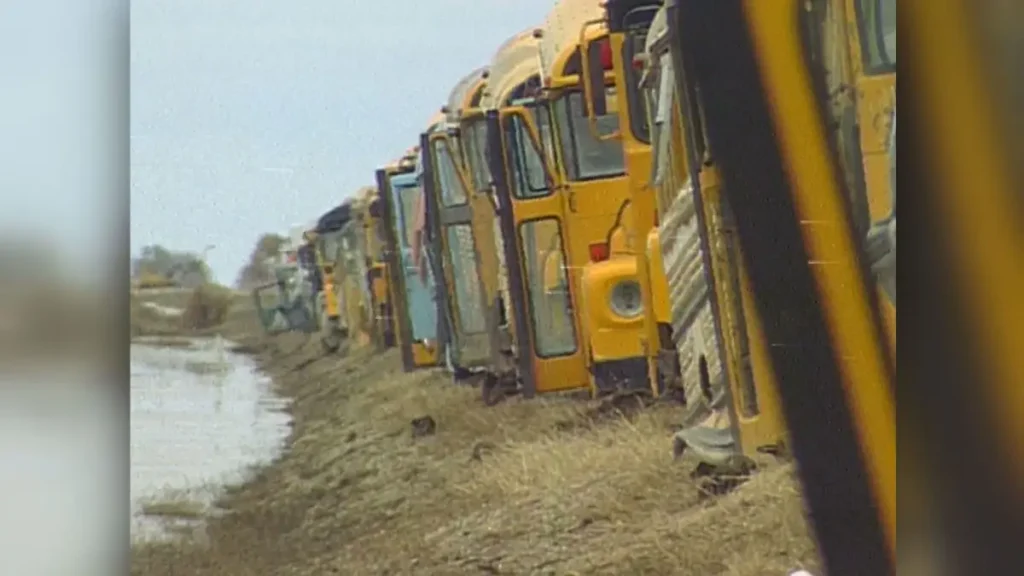
While BC’s and Quebec’s spring floods are vicious, instant and unpredictable, Manitoba is so flat that flooding can be anticipated weeks in advance. In 1997, though, a major blizzard in April turned flooding forecasts upside down and the province had only a week or so to build this immense wall. It worked, as did the floodway and today, the city boasts that it can withstand a 1-in-700-year flood, thanks to the remains of the Z-dyke and the expanded floodway.
But spring floods are extremely varied, and in 2026, the floodway was opened only for a day or so, with Duff’s Ditch seeing almost no water flow north.
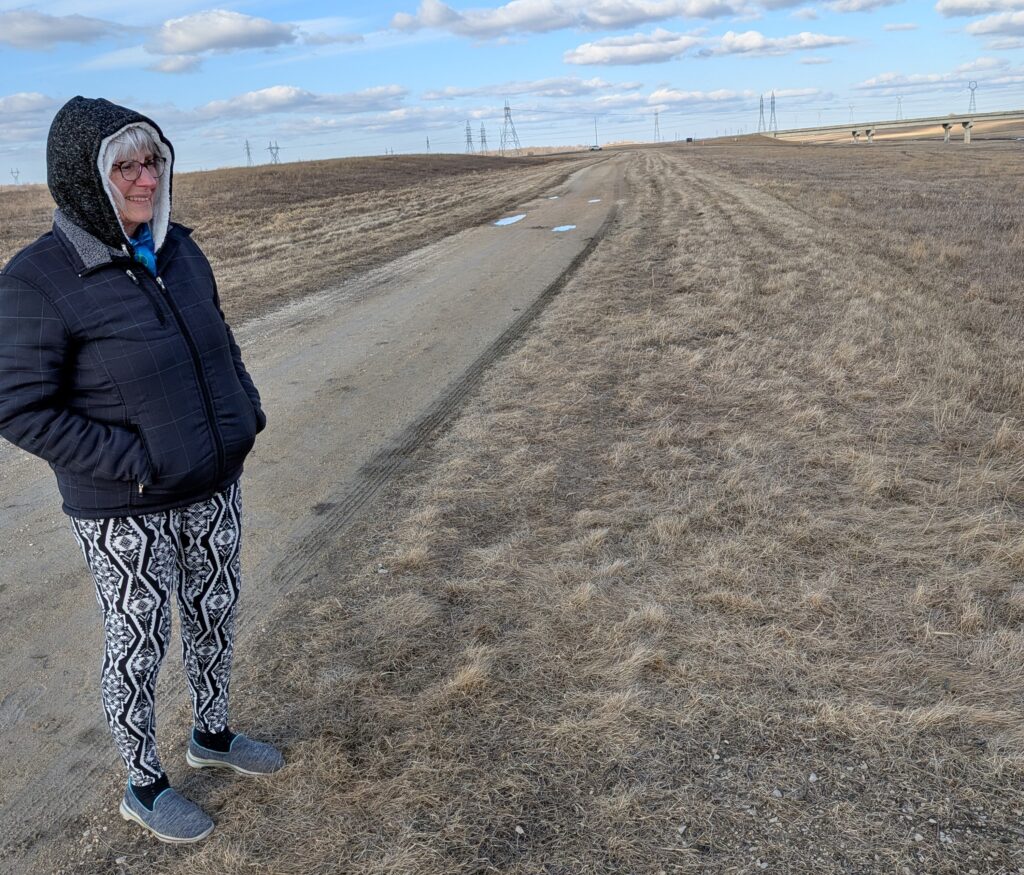
Instead, it had become a favourite place for birders, nature lovers, hikers, cross-country skiers, cyclists and even off-road riders to enjoy the outdoors on its banks year-round.
Winnipeg’s The Forks HIVE: Historic, Inclusive, Vibrant, Entertaining
Six thousand years ago, First Nations bands gathered at the junction of the Red and Assiniboine Rivers in spring and summer, trading, celebrating and reconnecting.
While this historic site gave way to commercial enterprise as pioneers moved into the province, becoming the heart of Winnipeg and the core of its downtown area, the native community never forgot its roots. Over the past 47 years, the provincial, federal and city governments began redeveloping and focusing on the historic roots of the site.
Today, it is an eclectic mix of facilities, with retail and dining experiences flooding the old Johnson Terminal and Forks warehouse. Nearby, the VIA rail station celebrates it history in the area, the Children’s Museum offers an abundance of experiences for kids, the Manitoba Theatre for Young People provides theatre for youth, a world-class skate park attracts scores of young people every day, and the CN stage is home to weekly shows.
The Human Rights Museum places Winnipeg at the heart of celebrating and supporting human rights in all its forms.
Travel Manitoba headquarters in the Johnson Terminal and the Agowiidiwinan Centre teaches visitors about First Nations history.
History is alive at the Forks!
But The Forks is very inclusive, as well. Both under the centre court canopy and at the CN stage, myriad cultural celebrations occur. Children and families enjoy outdoor activities year round, with over 2 kilometers of walking paths along interpretive monuments, the two rivers and the natural canopy of trees, along with winter skating paths throughout the site and between 6-11 kilometers (depending on the intensity of the winter) of skating trails along the Red and Assiniboine Rivers make winter thoroughly enjoyable. Older visitors can find dozens of places to relax and enjoy the surroundings, and all venues at the Forks are handicapped accessible.
Every weekend throughout the year, the two indoor public retail and restaurant buildings see thousands of visitors. From winter’s Festival du Voyageur to Canada Day celebrations, there is a buzz of celebration at the Forks.
While large commercial entertainment activities generally occur elsewhere in the city, the wealth of local entertainment, cultural celebrations and unique activities provide entertainment for every age from every background.
When visiting Manitoba, The Forks is an essential day trip for everyone. For locals, it can be a weekly pilgrammage.
Day Trip Through the Interlake
We’ve been spending a lot of time travelling in EastMan the past several weeks, so we decided to visit my old stomping grounds in the Interlake.
Growing up in Woodlands in the 1960s meant that your travel generally was limited to Winnipeg, Stonewall and sometimes Selkirk. Very rarely, we travelled north to Lundar to visit relatives. We had missed out on a lot!
Our route took us along Highway 6, east along Highway 68, south via Highway 17 and back to Winnipeg following Highway 7. Total travel time, with stops, was just over 5 and a half hours.
Normally, we only stop once for a meal, but today, twice.
Our route takes us northwest of the city, along the eastern edge of Lake Manitoba. Driving past Woodlands, my home town, I’m struck by how much it has expanded in the past fifteen years, with many new homes owned by the Plymouth Brethern, a very private religious sect. Our first stop, though, is MTT Restaurant, about five kilometers south of St. Laurent.
This restaurant has been operating for fifty years, and serves truckers travelling Highway 6 into northern Manitoba, many day-trippers from the near dozen First Nations reservations along the way, the beachgoers and cabin owners in Laurentia Beach and Twin Beaches on Lake Manitoba, and myriad locals. It always offers an excellent meal, along with a few groceries.
Nearby, Manipogo Golf Course and Manipogo Provincial Park were named for the mythical Manipogo monster of the Lake, a combination of Ogipogo (British Columbia), a moose and the Lock Ness monster. While I have never seen it, others, often well under the influence, swear that they have. However, since Lake Manitoba is less than 20 feet deep at its deepest, this monster must have a fear of deep lakes.
St. Laurent is home to one of the largest Metis populations in the province and was the town that the Smithsonian Institute turned to for its exhibit on Metis culture.
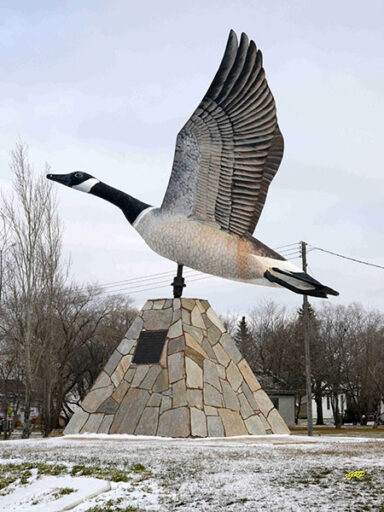
Oak Point is more a point on a map than a town, but there is a motel in the vicinity of where Oak Point should be. But the next town, Lundar, has more to notice. First, It has a giant Canada Goose statue that doubles as a weathervane. Second, it had one of the sallowest, sandiest beaches in the province. Third, it is home to an Icelandic, Scottish and Scandinavian population that settled here after New Iceland was founded in the 1800s, along Lake Winnipeg.
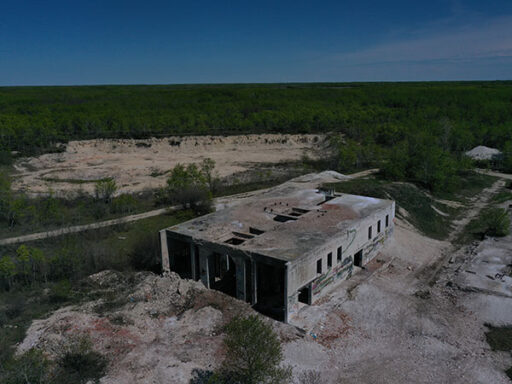
Now, we are at Eriksdale. We briefly stop at Havakeen Lunch t the junction of Hwy 68 nd 6. We often eat here, whenever we are travelling through. However, it is merely a washroom break today, and an opportunity to watch the numerous ruby throated hummingbirds feeding at the feeders.
Eriksdale has a museum that sprung from a former creamery, as well as a credit union, garage, decent grocery store and restaurants, so it has all a person needs on a daily basis.
Highway 68 crosses the Interlake all the way from Highway 6 to Highway 8 near Riverton (hence, “68”), but we are only travelling to Poplarfield. Here, a giant statue of a deer, “King Buck,” is a popular tourist stop. Across the highway from the king, a combination post office, grocery store and restaurant serves travellers on Hwy 68, as well as those travelling north or south from the three First Nations reservations on the route, along with the small communities of Fisher Branch and Hodgson, and the two Hutterite colonies, including Marble Ridge. King Buck is only one of several large animals in the area. Others include moose and black bear.
We turn south on Highway 17, toward Inwood. This route takes us past the Narcisse Snake Dens, which teem with tens of thousands of red sided garter snakes in mid-spring and sees thousands of snakes slithering back to their limestone dens in September. The snakes, like almost every animal in the province, are harmless. They are not venomous. And the bears, bobcats, foxes, wolves and coyotes in the Interlake may have reputations, but there have been no injuries, maulings, deaths or even serious attacks by these animals in recent decades.

Inwood is an interesting community. It seems to be in the middle of nowhere, but it has a garage, retirement home, school, grocery store and, of course, Rosie’s Restaurant. Just two or three miles north, the Inwood Quarry is home to a garter snake population almost as large as that in Narcisse. A statue in the heart of Inwood shows a ball of snakes entwined.
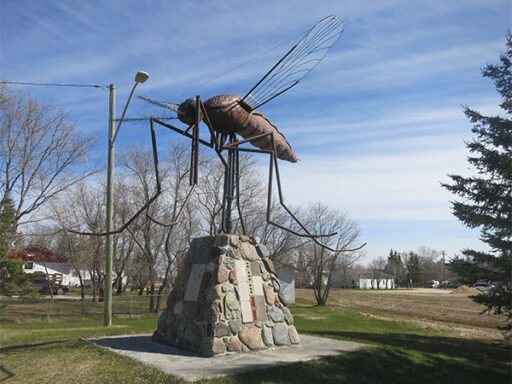
Now we continue past Norris Lake, a small lake in a small provincial park, with a few cabins and camping spots. Just northwest of Teulon, Komarno boasts the largest mosquito statue in the world. Many disagree. They claim that the statue is only a lifesized replica of an actual mosquito in the area.
Hwy 17 meets Highway 7 at Teulon, and it is here where we stop to eat again, There are a couple of great eating places in town, but we opt for the restaurant on the corner of the highway and the provincial Road that heads toward Winnipeg Beach. It’s just snack time, a drink, ice cream and an order of fries.
Teulon is a relatively sizeable small town, and recently it has seen an influx of people who commute the 55 minutes to Winnipeg each day.
We continue down Highway 7 to Winnipeg, bypassing Stonewall and Stony Mountain. Stonewall is fairly sizeable and we intend to spend a full day there soon. This year, the torrential rains have washed out the strawberry fields where thousands of people pick berries each year, so that trip will have to wait until 2027.
We’re back in Winnipeg, driving our electric vehicle, and did not require a recharge on the entire route.
Next trip? To Altona Sunflower Festival.