Claude grasped his stainless steel coffee mug with both fingerless-gloved hands. Even though it was a thermal mug, the warmth that penetrated from within was welcome. He was unsure why he was here, chilled, damp and uncomfortable. Except for tradition. His father had been here. And his father, prior to that. And his father, too. Before that, he was unsure, since none of the family had ever bothered to trace their roots. It didn’t matter. He was here because he should be here, and, except for the hot coffee to alleviate the cold, nothing much had changed for four generations.
While the mug was warm, the contents were doubly warm. Coffee, with a little cream. And a lot of rum. A second mug, dug into the earth nearby. Science said that alcohol did not warm. It dilated the pores, or the veins, or something, and actually chilled you. Hell, it felt warm to him. He belted back a solid swig, feeling the heat of the coffee and the sting of the alcohol wending down his oesophagus. The shine of the steel would not matter for at least another twenty minutes, since the sun had chosen not to awaken just yet. Cold and dark. Why was he here, again?
In the near distance, he heard the dull, echoing thud, repeated, pausing for mere seconds, and then repeated. It was the Morse code of the season: goose-hunting season. He, only half-aware, checked his own 12 gauge to make sure it was loaded and ready. Once before, he had failed to load the #2 shells into the clip, and had watched as a covey of partridge had erupted in front of him and beat a drummer’s path into the sky. The sound of their rapidly beating wings sounded like laughter to him.
Claude had responded instantly, if not instinctively. In frustration, he had thrown his gun at the birds, blaming his gun for failing him. Of course, the gun had missed them, but it had found the trunk of a tree at the edge of the thicket from which the birds had been flushed. As luck would have it, trunk met stock, and he had been obliged to have the gun repaired that day. To add insult to injury, as he picked up the gun from where it had fallen, he discovered that it had been he and not the gun that had been to blame for the failure to fire. The laughter of his hunting buddies had been real, even if the wing beat laughter of the Hungarian partridge had only been imaginary.
He could not say that he loved hunting. He was country, and country boys were supposed to hunt. He could not even say that he liked hunting. He liked being part of the feel of the community, and, therefore, he needed to hunt.
At one time, hunting had been essential. Meat from ducks, geese, partridge, bear, moose and deer would carry his father’s father’s family through difficult winters, inexpensively. His father had supplemented beef and pork from the farm with wild game, too. But Claude had no use for the taste of wild, or the inconvenience of reaching a clean hand into a cavity filled with warm entrails and dripping, sticky blood. He disliked plucking feathers, or running a knife under warm layers of fur, skin and flesh, to get at the red, Jell-O-like meat. Her hated the breaking of bones, the severing of heads, or the slicing of rib and rump into edible parts. And, he had calculated that it cost nearly two times the amount to kill wild game than it did to buy the equivalent in ham or beef. Hunting was only essential because he did not want to lose face.
The sound of the vanguard Canada geese whispered and squeaked in the distance. They were rising off Lake Winnipeg, heading out to the grain fields for their first meal of the day. Soon, the sun would rise, and the clouds of geese would cast rapidly moving shadows in front of its long morning face. They would rise, and fly westward to the fields. Hundreds upon hundreds. He had heard news stories claiming that there were now more Canada geese, brants and snow geese in the region than there had been in 1900. It was because there were so many hectares of grain now, providing a massive buffet for migrating birds. It was a buffet that demanded a heavy price, with barrage after barrage of shotgun shells fired in their direction as they landed and took off.
The Interlake region of Manitoba was ideal hunting ground. Between two large lakes and marshes, the area also was the flyway of the largest migration pattern in North America. And, along the route, hundreds of thousands of acres of recently harvested fields lay, inviting the birds. As well, in the autumn, northwest winds prevailed. The shortened the flights from field to water that the birds travelled three times each day. That translated to condensed prime hunting areas, within five to ten miles of each slough, lake or marsh.
The winds played into the hunters’ hands, as well. Many of the fields had a stand of bush at their headlands, predominantly to the south and east. A smart hunter could set his blind a hundred yards in from the headlands, and wait out the birds in his truck, until a half hour before dawn. In that time, he could finish off a half bottle of booze, if he chose. The hundred-yard trek could be covered in less than two minutes.
The birds landed the way a plane landed: into the wind, mostly. Since the only way to shoot a goose was to wait until it was slightly past you, and fire the pellets at the rear of the bird. Shot shell pellets travelled less than eighty yards, and killed at less than fifty. If you shot at the bird as it was approaching, the shot would bounce off the thick feathers that were sloped backward. Shoot as it passes you and the pellets could penetrate under them. As the birds landed, their airspeed slowed, giving extra seconds to fire three or four rounds. Hunting was a science. Claude disliked science.
At thirty-eight, he was on the cusp of middle age. The cold was colder, the wet was wetter than it had been when he first started hunting with his father, at the age of twelve. Even though the conditions had changed, he knew he was not the man he had been when he was still a child. Back then, they had dug into the black earth of the fields to hollow out a blind, then covered themselves with straw to conceal themselves. Geese were both dumb and smart, and could spot discrepancies easily. The had to keep the glint off their gun barrels, had to were sunglasses that did not reflect, and had to keep covered in the itchy straw. You would rise slightly to shoot, re-cover yourself with straw between flights and volleys and remain motionless in between. Today, he was reclining in a camouflage blind that he had purchased at Cabelo’s, laying on a foam mat to keep out the cold, and was dressed in microfiber hunting gear. He was still uncomfortable.
The geese were more active now. He turned off his IPod, to hear better, and rechecked his old Mossberg shotgun.
An hour later, he collected his four birds, pocketed the eighteen shells he had expended, folded is blind, and walked back to the truck. It was time to head home for a nap before the workday started.
Claude no longer hunted deer, moose or bear. He told no one else why, other than to lie to them, and say that he didn’t have the freezer space for the meat or the time to devote to the prolonged, full-day hunting trips. He had not hunted bigger game since he was twenty-six. The real reason was the buck’s head and antlers. Not the one hanging in his father’s recreation room in the basement, though.
Partridge season and goose or duck season ran from mid-September to early November in this area. Deer season for archers started in September, for muzzleloader hunters in October and for rifle hunters in November. And partridge loved the same terrain as deer. Gavin and Claude, long time friends, also had been constant hunting companions since they were fourteen. Today, they were hunting chicken and partridge, Claude with a .22 rifle and Gavin with his sixteen-gauge shotgun. Gavin flushed the thicket while Claude walked the perimeter, then they reversed. It gave each equal opportunity to shoot. The one proviso: the thicket hunter could not shoot to the rear, and the one outside the brush, walking slightly behind the other, could not fire forward. It was a safety measure, to ensure that they did not shoot each other. Friends were never in season.
At this moment, Gavin was flushing.
Hunting could be beautiful. Fall foliage, crisp mornings followed by sunny, calm days, whispering of drying leaves, calls of birds passing through the region on their southbound journeys. He loved autumn, he loved friends and, at 26, he loved hunting. It was a season and an age or irresponsibility. Today, no wind. 16 degrees C – a warm early October day. Claude had not bothered to join in either the duck hunt or goose hunt earlier. Two in the afternoon, and the sun was at its apex, its warmest. Still, quiet, clean, refreshing.
Branches crackled and broke. Shrubs and brush gave way to the rush of some large being. Then Gavin cried out. “Claude.”
A bear? A wolf? They were common. Gavin in jeopardy? Claude swung to his right, to where the sound was blasting in toward him. Should he run?
“Claude!” More frantic. Then, Boom! A second explosion, then the crushing sound of something falling, feet from where Claude stood, transfixed. The brush was too dense to see into.
“Gav.” He shouted back to his buddy. “Gav.” Was he okay. Seconds were minutes.
Then, “Claude, did you see it? Is it there?”
Gavin was okay. Claude relaxed slightly. Gavin emerged from the thicket, ten feet to Claude’s left.
“What was it?”
“A buck. A huge motherf..g buck. Where is it? Why didn’t you fire?”
Claude had two reasons. He hadn’t seen anything, for one. Second, he would have had to shoot forward, into the willows, in the direction of where Gavin should have been. Gavin had not been so thoughtful, shooting back and toward Claude. He had been lucky.
The two beat their way toward where the sound had died moments earlier. Claude was first to spot the deer. It was, as Gavin had proclaimed, huge, lying there, half supported by a fallen tree trunk. Its chest heaved, its huge, brown eye reflecting the panic that death brought. It spotted the two, and its front legs pawed as if it were leaping. Its back convoluted, attempting to mimic the flight that the brain wanted to initiate. Rear legs flailed. One or both of the shots had torn ugly holes through brown fur, just inches below the spine. The deer would die. At fifteen feet, shotgun pellets still were bunched tightly. The light-duty sixteen-gauge had torn into the back of the animal like a slug, but only deep enough to shatter the vertebrae.
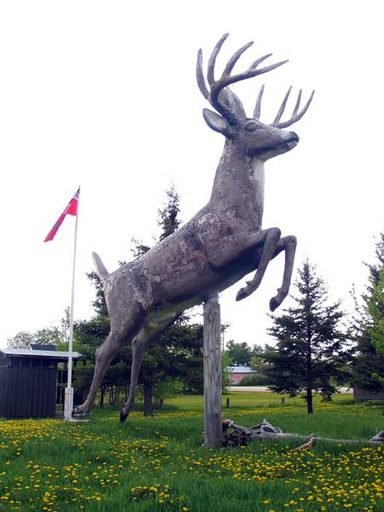
Both men watched, as the animal contorted. Deer, it was believed, did not vocalize. This one whined. Its eyes, whites showing now, rolled. Panic and fear distorted its features. Animals had no feeling? Like hell. This one showed fear, pain, sadness, confusion, all in seconds. The seconds became a minute.
“You going to finish it off?”
“No way. Not with my .22,” Claude responded.
“Someone has to.”
Neither could look the deer in the eye. Each saw humanity, where they knew no humanity existed. It was emotion, yet wild beasts had no emotion. They had known that to be true since they were kids. Emotion bled from the one eye that the buck revealed.
“He’s not dying.”
The “it” had become a “he.”
“We’ve got to put it out of its misery.”
Gavin reached for the remaining three shells that he had in his pocket.
“Damn. They’re gone. They must have fallen out somewhere. You’ve got to do it.”
Claude reluctantly checked the long sleeve of cartridges in his rifle, then placed the gun at the neck of the suffering thing. He could not shoot where it was most likely to be effective – through the eye and into the brain of the deer. He had not the heart. Then, he fired.
The deer twitched. So did Gavin. So did Claude. But the shot had merely brushed the thick fur at the nape of the neck. Claude inched closer, and fired deeper into the woolly mass. The deer convulsed. Gavin looked away. Again, Claude readjusted position and fired, again needing to find a better spot. He knew what he should do. He just did not have the heart. Gavin had stepped a few feet back. The deer knew what was coming. Twelve more shots, most in desperation, each closer to the deer’s head. Finally, the beast, having become more human while the hunter became more beastly, kicked its last. The eye remained open, but neither man could meet its dead gaze.
Neither Gavin nor Claude hunted big game after that. Gav escaped, moving to the city. Claude remained. Neither could eat the venison. It was still the deer that they had killed, regardless of the pretty label attached to its flesh. Other friends drew up the carcass, wrapped, froze and then chewed on the cooked muscle and flavourful flesh.
Claude rationalized. A large animal, with a larger brain, could have emotions and feelings. He could not hunt a being that could think. But geese and ducks? Small head, no brain to speak of. No emotion, no sense. Just instinct, wings and loud noises, along with a devastating ability to destroy crops. He was doing the world a favour by hunting. So he did.
In his years, he had seen lots of solitary geese, long after they should have continued their southerly migration. He had observed lone geese returning to the lake, aimlessly seeking out a flock to join. He thought nothing of it. Until today.
The morning hunt had been mildly productive. His mother had eviscerated the four birds, and they were on their way to his parents’ freezer. The repairs and winterizing of his farm equipment had gone as scheduled, and now it was time for the late afternoon hunt. He was joined by his uncle, still an avid all-round hunter of everything permitted (and some not).
“Pass me the bottle.” It was probably the most common line between hunters. Drinking and killing went together. Claude passed the Crown Royal. It was the only rye people here drank, with the Diageo distillery that made the drink located only a few miles away. It was patriotic.
They sat in the truck, concealed in the trees along the headlands, watching the decoys that they had set out that morning. The geese would begin arriving soon. The guns were lubricated and ready. So were they.
Off toward the centre of the field, Claude noticed movement. “There, Norm.” He pointed toward the area.
Norman put his binoculars to his eyes.
“A goose. So what?”
“So what is it doing? Are the flights starting?”
Norman looked again.
“Nope. It’s alone.”
“Feeding?”
Exasperated, his uncle raised the glasses one more time.
“No, just hanging out.”
Claude took the binoculars.
“It looks like its searching. It is just wandering in a circle. His head is down, but he’s not feeding. Could he be injured?”
“Probably not. Probably lost its mate.”
Claude thought back to that morning, to the bird that had flown halfway across the field. He had not been able to find it, and had assumed that it had managed to escape. “So why is it still here?”
His uncle looked at him. “They often hang out when their mate is downed.”
In all his years of hunting, Claude had not considered that, yet he had observed solitary geese time and again. He did not bother to concern himself with dumb animals, without the ability to reason.
They finished the evening hunt, with only two birds to show for two hours. Hardly worthwhile. Then Claude returned home, not for the dinner that was awaiting him, but to check the Internet.
Claude had no problem verifying his uncle’s theory. Geese not only mated for life, but would stand by an injured or dying mate, even when imminent death threatened the surviving partner. Even after the injured mate had died, the survivor may choose to not mate again. Like elephants, they had memory. Claude thought on it, but sat to dinner within the hour, and enjoyed the goose that his partner had cooked. But the buck crept into his thoughts.
The next morning was miserable. Windy & wet, the harbinger of early winter. Claude returned to the field.
The goose remained, and Claude chose to worm his way as close as he could to the bird. Walking, he made it to within three hundred yards without alerting the goose. Crouching, he made it another fifty. Crawling, he came within two hundred. He raised his binoculars to zoom in. The bird raised its head momentarily, eying this intruder. His neck still arched in a mourning downward turn, the goose returned to its occasional honking and its slow circular pathway. Claude worked closer, then focused in on the centre of the circular route.
There was his injured bird from a day earlier. Barely able to twist its neck, it lay with one wing stretched out from its body. It watched its healthy mate intently. The survivor seemed to be nosing seed or straw toward its partner, comforting it. Claude crept closer, noticed but unheeded by either goose. His arms and legs cramped from the crawling, the wet and the cold.
Within twenty yards, he sat up. The birds briefly heeded, then locked their attention toward each other. The smaller, injured partner laboured. The larger – the male – raised its head toward Claude, as Claude raised his shotgun.
Eyes locked. The female seemed to plead with Claude, either for salvation or death. The male looked intently at Claude as if reviling him. Claude fired, and the female fell limp. Claude’s eyes began to flow with droplets. It was not raining.
The deed done, Claude rose, as the male flew a short distance away then swung in an arc toward the site of the murder. The man’s gun lay on the wet earth, as he trudged away. He had looked the being in the eyes before he had shot. He had not liked what he had seen reflected. He would hunt no more.