Manitoba Oddities & Strange Things
Manitoba may possess the status as one of the oddest provinces in Canada. Ours is not a passive history or static geography, climate or environment. There are innumerable strange things and Manitoba oddities to celebrate here. Some occur on their own. Some need a little prodding from us residents.
Nature in Manitoba Can Be Odd
Where would one find nearly 100,000 snakes in one spot, with tourists from around the world actually clamouring to visit? In Narcisse and Inwood, Manitoba! The red-sided garter snake possesses celebrity status. Every spring, around Mother’s Day, thousands emerge from their limestone dens to have a sex orgy, then slither their way into marshes and fields throughout the Interlake for the summer. Then, throughout September, they wend their ways home, often covering roads as they cross en masse. Indeed, not only are red-sided garters non-venomous and harmless, so is every other snake in the province.
Just as odd is the tiny, 4-square kilometre Spirit Sands desert in southwestern Manitoba. It looks and acts like a desert, with its shifting sand dunes and creatures like the skink (a gecko-like lizard) and hognose snake. Yet, it receives too much rain to be a desert. It also has cacti, just like a southern desert, if stunted and winter-hardy. The Devil’s Punch Bowl, in the centre, is 45 meters deep and eerie waters.
Let’s Talk About Lakes: More Manitoba Strange Things & Oddities
For a prairie province with borders to two US states, two adjacent provinces and a northern territory, it still has 16% of its border on the Arctic Ocean (or, more technically, Hudson Bay). Yet, much of the province’s peculiarities involve water.
First, we boast that we have 100,000 lakes. That doesn’t include thousands of streams, creeks and rivers. We have so many lakes that, as a tribute to our fallen soldiers during the wars, we named many of them after those heroes.
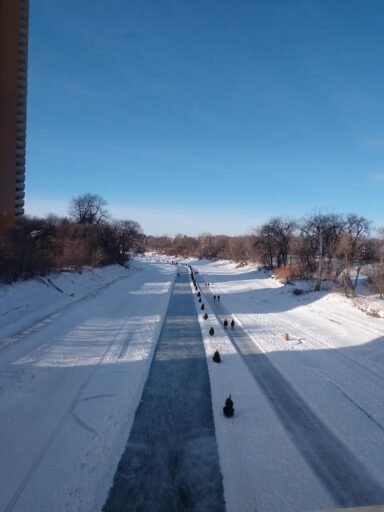
Winnipeg brags about its skating rink. It’s the longest skating rink that freezes naturally. At 8.5 km., it exceeds the Rideau Canal, running from the Forks south on the Red River and west on the Assiniboine River.
But water is more than lakes and rivers. One-sixth of our territory sits under water.
To the north, in Hudson Bay, Polar bears and narwhal whales call the water home. Our polar bears, the largest land carnivore in the world, rest and raise young all summer at a protected park near the Churchill River. The narwhal is unique. A whale with an extremely elongated tusk (tooth, actually), looks like an aquatic unicorn. It migrates along the first cracks in the ocean, every spring, near Churchill. Belugas play with tourists in the waters off the Churchill shore.
Lakes: Manitoba Oddities & Quirks
There are scored of lakes with unusual or quirky back stories. However, three are quite noteworthy.
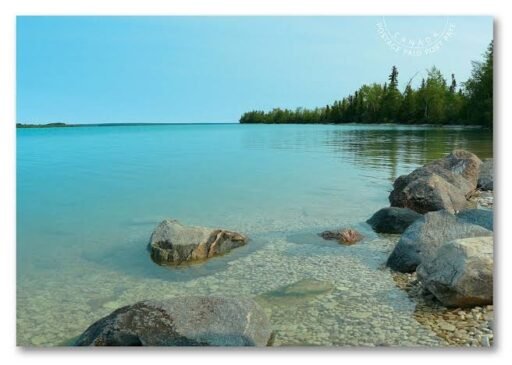
Little Limestone Lake, 500 km north of Winnipeg, is the world’s largest marl lake. This lake changes colour dramatically, depending on the temperature. It can change from robin’s egg to turquoise blue in a single day, then switch back to blue-grey as the water cools.
A meteor impact created West Hawk Lake, in the Whiteshell, driving the celestial missile 377 feet deep into granite igneous rock. Nearby, Falcon Lake is home to the most publicized UFO encounter ever photographed in Canada.
The south basin of Lake Winnipeg is equally unusual. Formed as the Agassiz Glacier retreated eons ago, this lake is still rising. Its depth does not change noticably. However, their basins and shores rise as the ground, compressed by the enormous weight of the continental glacier “springs” back at the rocketing rate of 10 centimeters every century.
Location, Location: Another Of Manitoba Oddities
Our geography dictates some of our oddities. Winnipeg experiences one of the largest temperature variations in a year: 65C. There are only a handful of cities over 500,000 people with larger variations. They almost all are in eastern Russia’s Siberia.
Being on the prairie and farther north than most communities, we experience very long days in summer. We brace for days with less than 8 hours of sun in winter. But the flat topography and thinner atmosphere allow for the light to diffuse. That, in turn, provides us with exceptionally long sunrises and twilights.
Our northern lights, the further north we travel, are spectacular. Clear, largely unpolluted air with few man-made lights, enhance the borealis effect. Many nights, you can hear and feel the crackling of this phenomenon all around you.
Then, of course, there is our celebration as being the Heart of Canada. It’s true. The longitudinal centre of the country sits just east of Winnipeg.
Man-made Manitoba Oddities
It is hard to fathom how a forest could be a man-made oddity, yet Winnipeg has the largest urban elm forest in North America, with 270,000 trees. Almost all planted.
Flin Flon, in northern Manitoba, gets its name from a fictional character in a science fiction novel. Flintabbatey Flonatin, the book’s hero, escapes an underground world via a gold-studded lake. A prospector found a copy of the book along a trail while searching for gold. Voila! The town found a name, and soon, found copper and zinc.
Winnipeg Floodway & Z-Dike
The Winnipeg Floodway and subsequent Z-Dike, built in the 1960s to mitigate against floods decimating Winnipeg, was the second largest earth moving project, next to the Panama Canal. To beat back the 1997 flood, the Z-Dike extended more than 30 kilometers. Diverting the flood of the century away. Then, the floodway underwent another expansion. Winnipeg can now survive one-in-five-hundred-year floods.
Roadside Statues
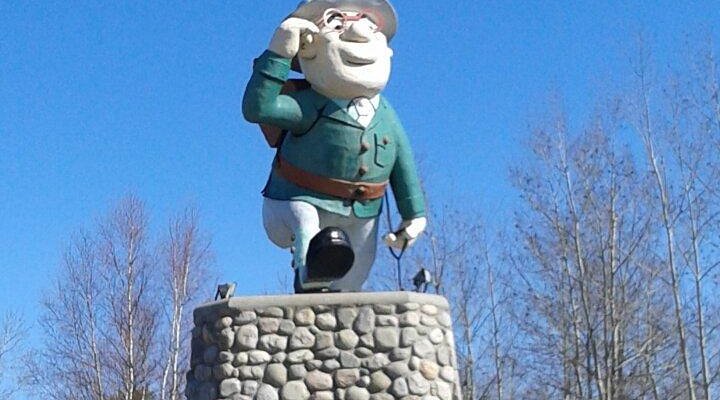
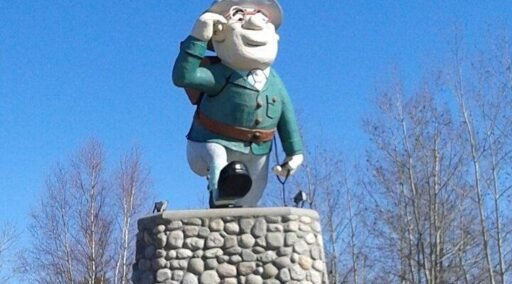
Including a giant mosquito, a Picasso painting and a weathervane massive goose statue, Manitoba boasts scores and scores of roadside monuments, signage and statues to spotlight towns and villages.
Arman Lemiez Sculptures
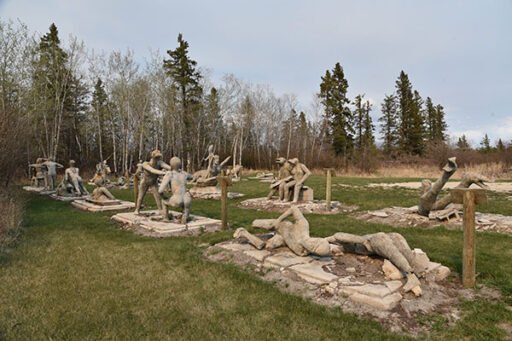
Perhaps the most unusual, if not the most professional array of statues stand in a farmer’s field, miles from any major centre. Mostly poured and shaped from hand-poured concrete, these were the labour of love of farmer Arman Lemiez. Abandoned for decades, they have found new celebrity near Moosehorn, Manitoba.
Winnie the Pooh: One of the Loveable Manitoba Oddities
Winnie was a bear cub donated to the London Zoo by Canadian soldier, Lieutenant Harry Coleburn. He named her Winnie, after his adopted hometown, Winnipeg. Author A.A. Milne visited the zoo with his son, Christopher Robin. The book, and the stories fondly savoured by millions, memorializes Winnipeg’s connection to this beloved characters.
Saving The Best Manitoba Oddity For Last
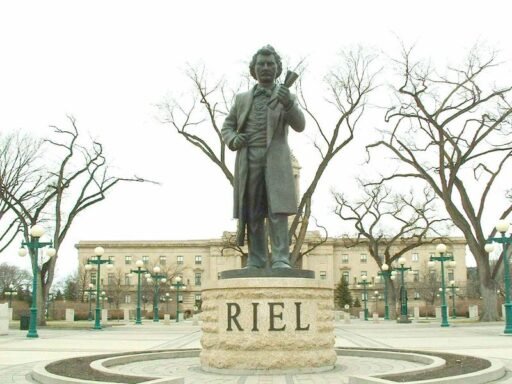
Manitoba was founded by Louis Riel, a Metis pioneer. But Louis Riel was a traitor to the country, according to the laws of Canada. So, a traitor, who started a rebellion against the government of what would be Canada in 1870, was hanged in 1885. Odd, since Manitoba became a province in 1870, due to his rebellion and his negotiated terms of entry. So, a province came into existence and the acknowledged founder was hung because of it. The federal government acknowledged this status in 1992. Yet, he has never been exonerated or pardoned!